Updated: May 2026
Family Bali Airport Transfer with Child Seat: Complete Safety Guide
Luxury Transfer Bali is a curated Indonesia luxury tourism experience offered by Luxurytransferbali Atlas: handpicked routes, vetted operators, transparent pricing, and 24/7 concierge support across Indonesia.
- What makes Luxury Transfer Bali a premium experience.
- How Luxurytransferbali Atlas curates exclusive access and concierge logistics.
- Routes, seasons, and pricing transparency — no hidden fees.
Family Bali Airport Transfer with Child Seat: Complete Safety Guide
What is a Family Bali Airport Transfer with Child Seat?
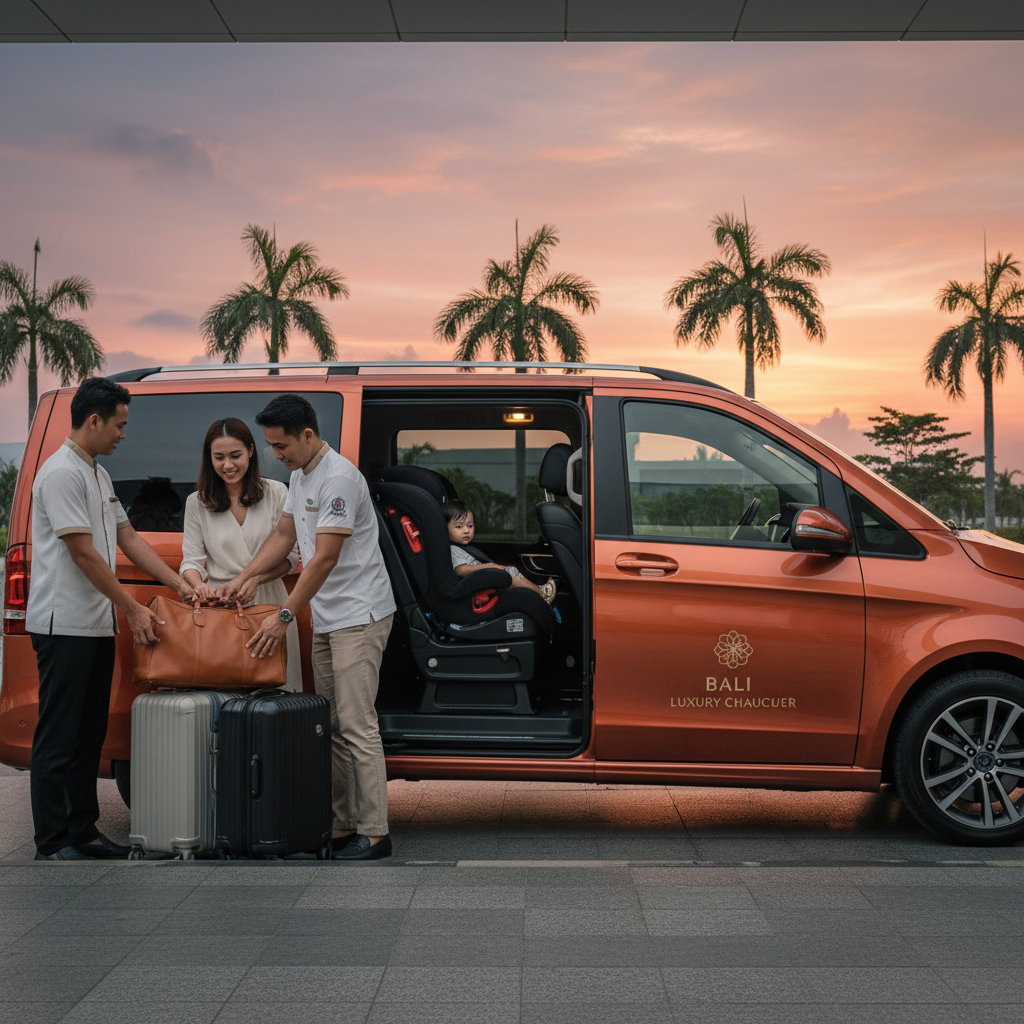
A family Bali airport transfer with child seat is a private chauffeured ground-transport service from Ngurah Rai International Airport (DPS) to your Bali resort or villa, performed in a luxury vehicle (typically Toyota Alphard, BMW X7, or Mercedes Sprinter for larger families) with manufacturer-certified child restraint seats pre-installed for each child passenger. Indonesia’s 2022 traffic law amendment recommends child restraints for passengers under 12 years and seatbelt use is mandatory in all seating positions. A reputable luxury operator carries rear-facing infant capsules (0–13 kg / 0–15 months), forward-facing convertible seats (9–25 kg / 9 months to 6 years), and high-back booster seats (15–36 kg / 4 to 12 years), inspects each before installation, and provides them at no extra cost when reserved at booking. Bali Luxury Transfer Concierge follows exactly this protocol with Maxi-Cosi and Britax ISOFIX-compatible seats sterilised between hires. Bali tourism portal
Why Bali Specifically Requires More Care for Family Transfers
Bali road conditions differ materially from a typical Western family travel destination. The Bypass Ngurah Rai highway from the airport into Seminyak features mixed traffic with high-volume scooter flow weaving between lanes, frequent unsignalled merges, and variable surface quality. Inland routes towards Ubud or Uluwatu include narrow village lanes with limited visibility around blind corners and frequent speed bumps. Standard taxi or ride-hail services almost never carry child seats, often have non-functional rear seatbelts, and may use vehicles older than 10 years with inadequate side-impact protection. A premium family transfer is therefore not a luxury preference but a substantive safety choice for travelling with children, particularly infants under 18 months.
Child Seat Categories Explained
Choosing the correct seat depends on your child’s weight, height, and age. Always defer to weight and height over age — a tall four-year-old may already need a booster, while a small four-year-old may still benefit from a five-point harness convertible seat. The three core categories are summarised below.
Rear-Facing Infant Capsule (Group 0+ · 0–13 kg)
For newborns through approximately 12–15 months. The seat installs rear-facing in the second row, supports the infant’s neck during sudden braking (the most common Bali traffic event), and uses a five-point harness with chest clip. Our standard offering is the Maxi-Cosi Pebble Pro or equivalent, ISOFIX-base mounted. We strongly recommend rear-facing position for as long as the manufacturer height limit allows — typically until 13 kg, though some seats accommodate up to 18 kg rear-facing.
Forward-Facing Convertible Seat (Group 1 · 9–25 kg)
For children approximately 9 months to 6 years. Forward-facing only after the child reaches the seat manufacturer’s minimum 9 kg threshold and the parent assesses the child has sufficient neck control. Five-point harness is the safety standard. Our standard offering is the Britax Römer KidFix or Maxi-Cosi Tobi.
High-Back Booster (Group 2/3 · 15–36 kg)
For children 4 to 12 years. The booster lifts the child to the correct seatbelt geometry so the lap belt sits across the upper thighs (not the abdomen) and the diagonal belt crosses the collarbone (not the neck). High-back boosters provide superior side-impact protection compared to backless boosters and are our default for any booster-age child.
Booster vs Convertible: Which to Choose
This is the most-asked family question. The honest answer is to use a convertible seat with five-point harness for as long as your child fits within the seat’s height and weight limits, then transition to a high-back booster once outgrown. A four-year-old at 18 kg should still be in a convertible seat with harness rather than a booster, because the harness distributes crash forces across the strongest parts of the child’s skeleton. Transitioning to booster too early is a common error driven by the child’s desire to feel grown-up. As a rule of thumb: harness until at least 4 years and 18 kg, booster until at least 1.45 m tall.
Indonesia Child-Restraint Regulations
Indonesia’s Law 22/2009 on Road Traffic and Land Transportation, amended in 2022, requires seatbelts in all seating positions of motor vehicles and recommends use of child restraint systems for passengers under 12 years and under 1.5 m height. While enforcement is currently advisory rather than penalty-driven for tourists, reputable luxury operators apply the spirit of the regulation by default. International best practice (UN Regulation 129 / i-Size, US FMVSS 213) is exceeded by the seats we deploy. We do not transport children without the appropriate restraint.
Pre-Arrival Family Checklist
To ensure a smooth airport meeting and onward transfer, we ask families to share the following at booking:
- Number of children and individual weight, height, age in months
- Specific seat preference if any (some families travel with their own seat)
- Stroller equipment — we accommodate full-size travel strollers in vehicle (Alphard or X7 recommended)
- Flight number for live tracking — we adjust pickup time automatically for delays up to 4 hours
- Resort or villa exact address — some Canggu and Ubud villas have access only via narrow lanes that the driver should pre-route
- Snack or hydration needs — we add chilled water, fruit, and crackers on request
Vehicle Selection for Families
Vehicle choice affects family comfort more than it does single travellers. The Toyota Alphard is our default family recommendation for two adults and one to three children: the high cabin makes child loading easy, the second-row captain chairs let parent and child sit together with comfort, and luggage capacity comfortably handles family checked bags plus stroller. The BMW X7 is suitable for active families with one or two children where the parent prefers a more elevated SUV driving position. The Mercedes Sprinter is the right choice for extended families of six or more, multi-generational trips with grandparents, or families travelling with abundant baby equipment (cribs, walkers, multiple strollers).
The Mercedes-Benz S-Class is generally not our family recommendation despite its premium credentials, because the rear cabin is shaped around adult lounge use and the lower roofline complicates child-seat installation. For families specifically wanting the S-Class, we accommodate one child in a rear-facing infant capsule on the rear seat. Detailed specifications across our fleet are documented on Our Luxury Fleet.
What Happens at Ngurah Rai Airport Arrival
Our chauffeur is positioned at the international arrivals gate 30 minutes before your scheduled landing time, holding clear name signage. We track your flight by IATA code in real time, so a delay of up to four hours is automatically accommodated without surcharge. Once you exit the gate, the chauffeur assists with luggage trolley, walks you to the vehicle in the airport carpark (covered, 200 m walk), confirms child-seat installation visually with the parent, and adjusts cabin temperature and music volume for the journey. Bottled water, baby-temperature water on request, and chilled towels are pre-loaded in the cabin.
Long Journey Considerations
For families with destinations more than 90 minutes from the airport (Ubud, Uluwatu, Sidemen, Lovina), we recommend a 15-minute mid-route stop at a clean rest area for nappy change, snack, and stretch. The Toyota Alphard’s rear cabin is genuinely roomy enough to perform a nappy change inside the vehicle if preferred, with the centre aisle and seat layout. For overnight arrivals, we dim the cabin and play soft white-noise audio on request to support infant sleep through the journey.
Booking Your Family Transfer
We recommend booking 7+ days in advance for high season (June–August, December–January) to secure the Alphard or X7 with your specific child-seat configuration. Last-minute bookings within 12 hours are possible based on dispatch reserve capacity. For full route options and pricing, see Luxury Transfer Bali. For multi-day chauffeur retainers when your family wants the same trusted driver for the entire trip, see Bespoke Bali Private Day Tours.
Reserve a Family Transfer
Email: bd@juaraholding.com
WhatsApp / Phone: +62 811 3941 4563
Specify at booking: Number of children, weights, ages · Stroller details · Flight number · Resort or villa address